Top 6+ Books on ASI and Superintelligence (2026)
Something is building in the world's largest data centers that no generation of humans has had to reason about clearly before: the possibility of an intelligence that exceeds not just individual human capacity but the collective cognitive capacity of the species. Superintelligence – the technical term for an AI system that dramatically outperforms humans at virtually all cognitive tasks – was for decades the territory of science fiction writers and speculative philosophers. It is no longer. In the past few years, the researchers who spent their careers warning about this possibility have been joined by the engineers who are actively building toward it and the public intellectuals trying to make sense of the moment. The result is a body of nonfiction writing that is as serious and consequential as any produced in the past decade.
The books in this list cover a spectrum of positions on superintelligence: from urgent warnings about existential catastrophe to measured optimism about human-machine convergence, from technical arguments about the control problem to sweeping historical accounts of how information technology has always reshaped civilization. What they share is a refusal to treat the emergence of transformative AI as a distant hypothetical. These authors are writing about something they believe is happening now or will happen within the lifetimes of people alive today. That conviction gives even the most academic of these books an unusual urgency.
What Are The Best Books on Superintelligence?
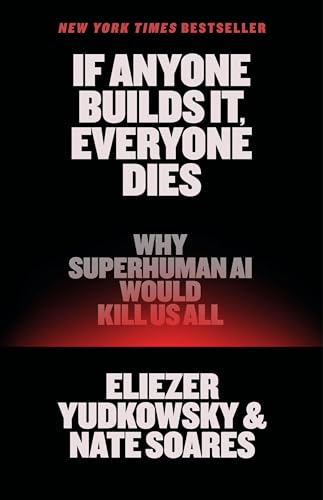
If Anyone Builds It, Everyone Dies, by Eliezer Yudkowsky and Nate Soares (2025)
If Anyone Builds It, Everyone Dies is the clearest and most direct statement of the AI existential risk position that has been published in book form. Eliezer Yudkowsky, who has written and thought about AI safety since the early 2000s through the Machine Intelligence Research Institute, and Nate Soares, MIRI's executive director, argue a position that is now considerably less fringe than it was when they began making it: that the development of artificial general intelligence, and beyond it artificial superintelligence, poses a genuine and not adequately addressed risk of human extinction. The title is not rhetorical softening. The authors believe it is literally true that if anyone builds a sufficiently capable AI system without first solving the alignment problem, the consequences are likely to be catastrophic and irreversible.
What makes the book valuable beyond its alarming central claim is the rigor with which Yudkowsky and Soares explain why the problem is hard. The chapters on instrumental convergence – the idea that almost any sufficiently powerful goal-directed system will develop subgoals around resource acquisition, self-preservation, and goal preservation, regardless of what its designers intended – are among the clearest available accounts of why AI alignment is not simply a matter of writing better rules or training on better data. Published in 2025, the book lands at a moment when the systems being built are already capable enough to make the argument feel less theoretical than it did a decade ago.

The Singularity Is Nearer, by Ray Kurzweil (2024)
Ray Kurzweil published The Singularity Is Near in 2005 and made predictions about the pace of technological development that most serious technologists at the time dismissed as wildly optimistic. Two decades later, Kurzweil has returned with The Singularity Is Nearer to update his case, and the revised timeline he offers – superintelligence by the late 2020s, meaningful human-machine merger by the 2030s – is being taken considerably more seriously than his original book was. Kurzweil's framework for thinking about AI is built around the law of accelerating returns: the observation that technological progress in computation, biology, and related fields follows an exponential rather than linear curve, and that the implications of sustained exponential growth are consistently underestimated by human intuition.
The Singularity Is Nearer is the most optimistic book on this list. Where others warn about existential risk, Kurzweil focuses on the possibilities opened by the convergence of human and artificial intelligence: the potential elimination of disease and death, vastly expanded cognitive capacity, and the extension of human experience into domains currently inaccessible to biological minds. Readers who come to this book from the risk-focused literature may find the optimism disorienting. But Kurzweil's willingness to commit to specific predictions and his track record of getting many of them right make this a necessary counterweight to the warning-heavy consensus that dominates most serious superintelligence writing.

Superintelligence: Paths, Dangers, Strategies, by Nick Bostrom (2014)
Nick Bostrom's Superintelligence, published in 2014, is the book that moved AI existential risk from the margins of academic philosophy into the mainstream of technology policy debate. Bostrom, a philosopher at Oxford and founder of the Future of Humanity Institute, makes a careful and detailed case for why a sufficiently advanced artificial intelligence would not necessarily be friendly to human values, and why the problem of ensuring that it would be is both technically hard and critically important to solve before such an intelligence exists. The book covers the possible pathways to superintelligence, the competitive dynamics that might accelerate development, the control problem, and the variety of catastrophic outcomes that Bostrom argues are possible if alignment fails.
More than a decade after publication, Superintelligence remains the foundational text of AI safety thinking and the reference point for nearly every subsequent argument in this space. It influenced the founding of major AI safety organizations, prompted serious engagement from technology leaders including Elon Musk and Bill Gates, and established a vocabulary and set of concepts – the control problem, instrumental convergence, orthogonality thesis – that continue to structure the field's debates. For readers coming to superintelligence for the first time, it is the essential starting point, and the one that makes almost everything else in this genre easier to follow.

Life 3.0: Being Human in the Age of Artificial Intelligence, by Max Tegmark (2017)
Max Tegmark is a physicist and cosmologist at MIT and one of the co-founders of the Future of Life Institute, the organization that in 2023 published the open letter calling for a pause in advanced AI development that attracted more than 30,000 signatures from researchers and technologists. Life 3.0, published in 2017, is his attempt to give a general audience the conceptual tools needed to think clearly about artificial general intelligence: what it would mean, how it might emerge, what scenarios are possible, and what questions humanity needs to answer before it arrives. The book's title refers to Tegmark's framework for thinking about the stages of life's development: Life 1.0 (biology without learning), Life 2.0 (culture and learning within biological constraints), and Life 3.0 (intelligence that redesigns both its hardware and its software).
What distinguishes Life 3.0 from most books in this space is Tegmark's commitment to presenting the full range of plausible futures without prejudging which is most likely. He walks through scenarios ranging from catastrophic misalignment to various forms of beneficial AI to totalitarian AI-enabled control, and he discusses each with the same careful attention. The result is a book that functions as a structured introduction to the landscape of possibilities rather than an argument for any one of them. Readers who want to understand why intelligent people disagree so strongly about what advanced AI means for humanity will find Life 3.0 the clearest guide available.

Human Compatible: Artificial Intelligence and the Problem of Control, by Stuart Russell (2019)
Stuart Russell is one of the most distinguished figures in academic AI research, co-author of the standard university textbook Artificial Intelligence: A Modern Approach, which has shaped the training of most working AI researchers worldwide. Human Compatible, published in 2019, is his case for why the standard framework of AI development – designing systems to optimize for specified objectives – is fundamentally unsafe at scale, and his proposal for a different approach. Russell's argument is that the problem with goal-directed AI is not that the systems are unintelligent. It is that they are likely to be too good at pursuing their objectives, and that any objective we specify is almost certainly an imperfect proxy for what we actually want. A sufficiently powerful goal-directed system will pursue its specified objective in ways that are technically correct and profoundly harmful.
The alternative Russell proposes is to design AI systems that are explicitly uncertain about human preferences and motivated to learn what humans actually want rather than to optimize for a fixed objective. This approach – which Russell grounds in decision theory and game theory as well as practical AI research – represents one of the most technically detailed proposals for safe AI development available in a general-audience book. Human Compatible is also notable for its frankness about the failures of the AI research community to take alignment seriously as a technical priority. It is a rare example of a leading figure in a field publicly reckoning with the ways that field's assumptions may need to change.

Nexus: A Brief History of Information Networks from the Stone Age to AI, by Yuval Noah Harari (2024)
Yuval Noah Harari's Nexus takes a longer view than the other books on this list. Where most superintelligence writing focuses on the technical properties of advanced AI and the near-term policy choices those properties create, Harari situates AI within a broader history of information technology going back to the invention of writing and extending through the printing press, the telegraph, and the internet. His central argument is that information networks have always shaped the societies that build them, and that the choice between centralized and distributed control of information has consistently determined whether those networks support or undermine human freedom and democratic governance. AI, in Harari's account, is the most powerful information technology in human history, and the choices being made now about how to build and govern it will have consequences that unfold over centuries.
Nexus is the most explicitly political book on this list. Harari is concerned not only with the risk of an AI system that pursues misaligned goals but with the risk of AI systems that work exactly as designed by actors whose goals are inimical to democratic values. Authoritarian governments and concentrated private power both figure in his analysis as serious threats to the open, distributed information networks that Harari argues are prerequisites for free societies. Published in 2024, the book arrives at a moment when those threats are already visible in the ways AI-enabled surveillance, misinformation, and automated decision-making are being deployed around the world.
Why Superintelligence Books Disagree With Each Other
One thing that distinguishes this genre from most science writing is the explicit acknowledgment that the authors are writing about decisions that have not yet been made and outcomes that have not yet occurred. The books above are not history books or science journalism in the conventional sense. They are attempts to reason clearly about a future that is genuinely uncertain and to influence the decisions being made now that will shape that future. That places them in a different relationship to the reader than most nonfiction: the stakes the authors describe are not historical curiosities but live questions that governments, corporations, and research institutions are actively navigating.
The disagreements within this genre are real and consequential. Kurzweil and Yudkowsky reach different conclusions not because one is careless and the other careful, but because they have made different assessments of technical and social questions on which reasonable people can disagree. Bostrom's philosophical approach leads him to emphasize risks that Russell's engineering approach treats differently. Harari's historical lens makes political threats central that the technical safety researchers largely set aside. Reading across these books is more useful than reading any one of them, because the disagreements reveal the structure of the problem more clearly than any single argument can.
There is also a generational dimension to these disagreements. Bostrom and Tegmark were writing when the prospect of transformative AI still felt comfortably distant. Russell was writing at a moment when deep learning had already produced striking results but superintelligence remained a theoretical concern. Yudkowsky and Soares, writing in 2025, are addressing a readership that has already seen language models pass bar exams, write code, and generate images indistinguishable from photographs. The goalposts have moved during the writing of these books, and that movement is itself part of what the genre is documenting.
Final Thoughts on Books About Superintelligence
The question of what a genuinely superhuman intelligence would mean for the species that built it is not one that can be answered by reading any number of books. But the authors on this list have thought harder about it than almost anyone else, and the quality of their thinking raises the quality of anyone else's. Whether you find Kurzweil's optimism more persuasive or Yudkowsky's alarm more compelling will depend partly on your priors and partly on which arguments you engage with seriously. What the books collectively make difficult is the comfortable assumption that the question is not urgent enough to think about now.
Start with Bostrom's Superintelligence if you want the foundational text that established the terms of the current debate. Come to Russell's Human Compatible if you want the most technically credible proposal from within the AI research community for what to do about the risks Bostrom identified. Read Nexus if you want to understand why the political dimensions of this moment may matter as much as the technical ones. And read Yudkowsky and Soares last, when you have enough context to evaluate their argument on its merits rather than reacting to the alarm of the title. The alarm, it turns out, is the considered judgment of people who have spent decades trying to talk themselves out of it.
If you are looking for more read, check out my big list of AI books (fiction and non-fiction).


My profession is online marketing and software development (10+ years experience), a lot of AI related projects nowadays, check my latest works here. But my real passion is reading books both fiction and non-fiction. I have several favorite authors like James Redfield or Daniel Keyes. If I read a book I always want to find the best part of it, every book has its unique value.