Top 6+ Books on How to Sell Your Online Product Without Spamming (2026)
In the vibe coding era, building an online product has never been easier. With AI coding assistants, a solo maker can go from idea to a working app, browser extension, or SaaS tool in a weekend. That is great news and bad news at the same time, because everyone else can do it too. When building is cheap, products are everywhere, and the competition for attention becomes brutal. Most makers respond with one of two bad habits: doing nothing and hoping people find the product on their own, or doing the loudest thing available, which today means firing off cold DMs to strangers on X until somebody bites. Neither works for long. The first leaves a good product invisible, and the second burns your reputation faster than it builds revenue. The good news is that there is a large middle ground between silence and spam, and some very smart people have mapped it out in detail.
The books in this list are about that middle ground. They cover product-led growth, choosing the right acquisition channels, permission-based marketing, community-first selling, positioning, and building products people come back to every day. They are especially useful for indie makers, small SaaS founders, and anyone running a freemium tool or browser extension who wants a real marketing plan rather than a spam schedule. Along the way, we will apply them to a real case: PI Labs, our own small suite of browser tools that I personally use every day, and the reason this whole reading list came together in the first place.
What Are The Best Books on How to Sell Your Online Product?

Product-Led Growth: How to Build a Product That Sells Itself, by Wes Bush (2019)
Wes Bush, founder of the Product-Led Institute, makes the case that for most modern software the product itself should be the main engine of acquisition, conversion, and expansion. Instead of a salesperson convincing someone to buy, the user gets real value from the product first, through a free trial or a freemium tier, and the purchase follows naturally once the value is obvious. Bush lays out how to decide between those models with his MOAT framework (market strategy, ocean conditions, audience, and time-to-value), and how to design onboarding that gets new users to their first meaningful win as quickly as possible.
What makes the book so practical is its focus on the gap between signing up and getting value. Bush calls it the time-to-value problem, and his “bowling alley” approach to onboarding is about removing every step that does not move a new user toward that first win. If you sell anything that people can try before they pay, this is the book to read first. It reframes marketing as a product problem: the best pitch you will ever write is a product that proves itself in the first five minutes, and the best upgrade prompt is one that appears exactly when the free version stops being enough.

Traction: How Any Startup Can Achieve Explosive Customer Growth, by Gabriel Weinberg and Justin Mares (2015)
Gabriel Weinberg founded DuckDuckGo, and Traction grew out of his frustration with how many founders pick a marketing channel by habit rather than by testing. The book catalogs nineteen traction channels, from content marketing and SEO to community building, partnerships, engineering as marketing, public relations, and targeted ads, with interviews from founders who made each one work. The core tool is the Bullseye Framework: brainstorm every channel, run cheap tests on the most promising few, and then focus hard on the one that actually moves the numbers.
For anyone whose current marketing plan is “post on X and DM people,” Traction is a wake-up call in the best sense. It shows how narrow that plan is and how many quieter, more durable channels sit unused. Weinberg and Mares also argue that founders should spend roughly half their time on traction rather than treating it as an afterthought once the product is “done.” The chapter on engineering as marketing, building free tools that attract the exact audience you want, is particularly relevant for anyone already shipping small utilities.

This Is Marketing: You Can't Be Seen Until You Learn to See, by Seth Godin (2018)
Seth Godin coined the term permission marketing back in 1999, and This Is Marketing is his most complete statement of what marketing looks like when you stop interrupting people and start serving them. His central idea is the smallest viable audience: instead of trying to reach everyone, find the small group of people who will genuinely care about what you make, understand their worldview, and build something that fits it so well they tell their friends. Marketing, in Godin's view, is the generous act of helping people become who they want to become.
This is the philosophical antidote to spam. Godin explains why interruption-based tactics get weaker every year, as people learn to ignore anything that was not asked for, and why trust and attention are the only assets that compound. His idea that culture spreads through the phrase “people like us do things like this” is one of the most useful lenses for any product that depends on word of mouth. It is a short, readable book, and it changes the questions you ask before you write a single post.
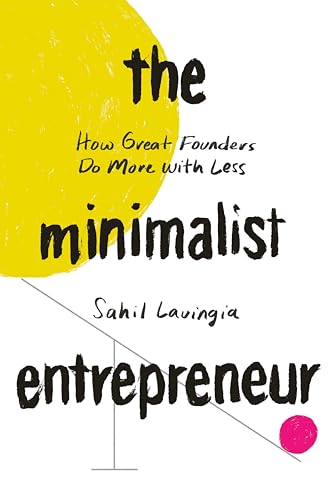
The Minimalist Entrepreneur: How Great Founders Do More with Less, by Sahil Lavingia (2021)
Sahil Lavingia founded Gumroad, and The Minimalist Entrepreneur is his playbook for building a profitable business without venture capital, a big team, or a huge launch. The sequence is simple and refreshingly honest: start with a community you are already part of, build as little as possible to solve a real problem for them, sell to your first hundred customers one by one, and market yourself by being yourself, teaching what you know in public rather than broadcasting ads.
The “first hundred customers” chapter is the most relevant thing in this list for anyone tempted to mass-DM strangers. Lavingia does recommend reaching out to people personally, but to people you already know, in communities where you have already contributed, about a problem they have already told you about. That is the difference between a conversation and spam. The book is short, direct, and especially valuable for solo makers who need permission to grow slowly and profitably instead of chasing viral moments.

Obviously Awesome: How to Nail Product Positioning so Customers Get It, Buy It, Love It, by April Dunford (2019)
April Dunford spent years launching tech products as an executive before becoming the go-to positioning consultant for startups, and Obviously Awesome is her step-by-step method for making a product instantly understandable. She breaks positioning into five components: the competitive alternatives customers would use instead of you, your unique attributes, the value those attributes enable, the customers who care most about that value, and the market category that makes all of it obvious at a glance.
Positioning is the problem hiding underneath most “marketing” problems. If people visit your site and leave confused, more traffic will not help, and more DMs certainly will not. Dunford's process is especially useful for products that do several things at once, where the temptation is to list every feature and hope something sticks. She shows how to choose a frame of reference so the right customers immediately think “this is for me,” and the wrong ones politely move on, which is exactly what you want.
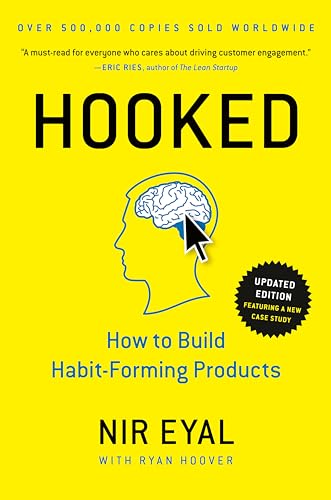
Hooked: How to Build Habit-Forming Products, by Nir Eyal (2014)
Nir Eyal, writing with Product Hunt founder Ryan Hoover, explains why some products become part of our daily routine while others are forgotten a week after install. His Hook Model has four stages: a trigger that prompts use, an action simple enough to take without thinking, a variable reward that keeps the experience interesting, and an investment, such as saved data, preferences, or progress, that makes the product more valuable each time it is used and makes coming back the obvious choice.
Retention is the most underrated form of marketing. A product people use every day sells itself through visibility, recommendations, and the simple fact that its users never leave. For daily-use tools, browser extensions, and anything with streaks, saved libraries, or personal history, Hooked is the manual for turning a useful product into a habit. Eyal also includes a thoughtful section on the ethics of habit design, which keeps the book on the right side of the line between building something people love and building something people cannot put down.
Why Selling Got Harder in the Vibe Coding Era
For most of the history of software, the hard part was building. If you could ship a working product, you were already ahead of most of the people who had the same idea. That moat is gone. AI tools have made it possible for almost anyone to produce a polished-looking product in days, which means that for any useful idea there are now dozens of near-identical tools competing for the same users, often launched in the same month. Features get copied in a weekend. Landing pages all look the same. “I built it” is no longer a competitive advantage. It is the entry ticket.
What still cannot be generated with a prompt is trust, a clear position in someone's mind, a community that knows your name, and a product that becomes part of someone's daily routine. Those are exactly the things these six books teach. In a world where building is cheap, distribution, positioning, and retention are the real product, and the makers who treat marketing as a craft rather than a chore are the ones whose tools survive past the launch week.
A Real Example: Marketing PI Labs Without the DM Spam
The reason this list exists is a very practical question. PI Labs is a small family of browser tools: PI Prompts saves and reuses prompts inside ChatGPT, Claude, and Gemini; PI Fix Grammar fixes text in any field on any site; PI Summarize turns selected text into a summary with one right-click; and Aviary turns daily activity on X into quests and streaks. Those four are free and need no account. A single Premium plan, starting at $10 a month, unlocks extras across all of them, including PI Answer for drafting X replies in your own voice and Ciocu, a voice companion that remembers your conversations. The tools already have more than 2,100 Chrome Web Store users. The question was simple: what is the next step, if the answer is not “message more strangers on X”?
Read through the lens of these six books, the plan almost writes itself:
- Treat the free tools as the sales team (Product-Led Growth). The free extensions are the funnel. The job is to shorten the time from install to first win, and to show the Premium upgrade at the exact moment a free user hits the limit of what the free version can do, not on day one.
- Test channels beyond X (Traction). Chrome Web Store optimization, SEO pages for each tool, comparison pages against well-known alternatives, launch sites like Product Hunt, and genuinely useful free mini-tools are all worth a cheap test. Keep the one that works and go deep.
- Pick the smallest viable audience (This Is Marketing). Not “everyone who uses a browser,” but a specific group, such as people who live inside AI chat tools all day or creators who post on X daily, and speak only to them.
- Sell inside communities you already belong to (The Minimalist Entrepreneur). Share what you are building, teach the workflows the tools make easier, and talk one by one with people who already have the problem. That is outreach people welcome.
- Position the suite clearly (Obviously Awesome). Several tools under one plan is a strength, but only if the homepage makes the category obvious in five seconds: for example, an AI writing toolkit that lives in your browser, rather than a list of eight product names.
- Double down on daily use (Hooked). Saved prompt libraries, streaks in Aviary, and Ciocu's memory are all forms of investment. The more each tool gets better with use, the less marketing it needs, because people stay and tell others.
To make this process repeatable, we distilled all six books into a single AI skill file: the Sales & Growth Skill. Drop it into Claude, ChatGPT, or Gemini, describe your product, and say “audit me.” It scores your product on positioning, time-to-value, audience, channels, and habit, names the single biggest bottleneck, and turns the frameworks from these books into a concrete plan, with hard rules against spam built in. It is the same process we used to map out the next steps for PI Labs, and it works just as well for any app, SaaS tool, browser extension, or digital product.
None of these steps requires a bigger budget or a louder voice. They require patience, a clear message, and a product that earns its place in someone's day. That is the shared lesson of every book on this list, and it applies just as much to a tiny browser extension as it does to a venture-backed SaaS company.
Final Thoughts on Books About Selling Your Online Product
Selling an online product well is not about tricks. It is about making the value obvious, putting the product in front of the right small group of people, and letting usage, trust, and word of mouth do the heavy lifting. Product-Led Growth shows how to let the product sell itself, Traction shows where else to look for customers, This Is Marketing explains why permission beats interruption, The Minimalist Entrepreneur shows how to start with people who already trust you, Obviously Awesome makes your message land, and Hooked keeps your customers coming back.
If you only read one, start with Product-Led Growth if you have a free version, or The Minimalist Entrepreneur if you are still finding your first customers. Then come back to the rest as your product grows. And the next time you are tempted to send fifty copy-pasted DMs, close the tab and spend that hour improving your onboarding instead. It will sell more, and nobody will mute you for it.


My profession is online marketing and software development (10+ years experience), a lot of AI related projects nowadays, check my latest works here. But my real passion is reading books both fiction and non-fiction. I have several favorite authors like James Redfield or Daniel Keyes. If I read a book I always want to find the best part of it, every book has its unique value.