Top 6+ Mathematician Books for Kids That Make Math History Come Alive (2026)
Some of the most remarkable stories in history belong to people who simply could not stop thinking about numbers. Mathematician books for kids bring these real-life geniuses to life and show young readers that curiosity, stubbornness, and a love of patterns can change the world. Whether your child is already a math enthusiast or has never thought of numbers as anything more than homework, the right book can flip a switch.
The books on this list span centuries and continents, featuring boys and girls, outcasts and prodigies, all united by one thing. An unstoppable passion for mathematics. Each title is a picture book biography aimed at readers roughly ages 8 to 12, and every one of them is as much a story about character and determination as it is about math.
What Are The Best Mathematician Books for Kids?

Blaise Pascal: The Boy Who Couldn't Be Stopped from Doing Math, by Kimberlee Everson (2025)
Blaise Pascal's father had one rule for his son and it was a simple one. No math until you are older. What makes this book so charming is how completely that rule fails. Young Blaise sees patterns in everything around him, in the way raindrops fall, in the shape of sunflowers, in the rhythm of numbers, and no parental decree can stop a mind like that. At just twelve years old he works out a mathematical truth entirely on his own, without anyone teaching him.
I think what Dr. Kimberlee Everson does really well here is show the joy of discovery rather than the dry mechanics of math. By the time Blaise is sixteen he has uncovered what we now call Pascal's Triangle, a remarkable arrangement of numbers that turns up in nature, science, and even modern computing. For a picture book that is a lot of ground to cover and it covers it beautifully.
In my opinion this is one of the best introductions to the idea that mathematical thinking is not something you learn at school but something some people simply cannot switch off. Kids who feel that way about numbers will see themselves in Pascal. Kids who do not may just start looking at the world a little differently after reading it.

The Boy Who Loved Math: The Improbable Life of Paul Erdos, by Deborah Heiligman (2013)
Paul Erdos is the kind of person who sounds made up. He was born in Budapest and by the time he was a small child he had taught himself to read and could multiply four-digit numbers in his head for fun. He grew up to publish more mathematical papers than almost any mathematician in history, not by settling down at a desk but by wandering the world with a single suitcase, showing up at colleagues' homes and announcing that his brain was open.
Deborah Heiligman tells this story with real warmth and the illustrations by LeUyen Pham are some of the most joyful I have seen in a picture book biography. There is something genuinely moving about a man who never quite fit into ordinary life but found his home in the company of other people who loved numbers as much as he did. I think that is a feeling a lot of mathematically-minded kids will recognise.
In my opinion the best thing about this book is that it does not try to smooth over Erdos's eccentricities. He was odd, he was obsessive, and he was also generous and kind and brilliant. That combination makes for a much more interesting story than a tidy hero's journey ever could.
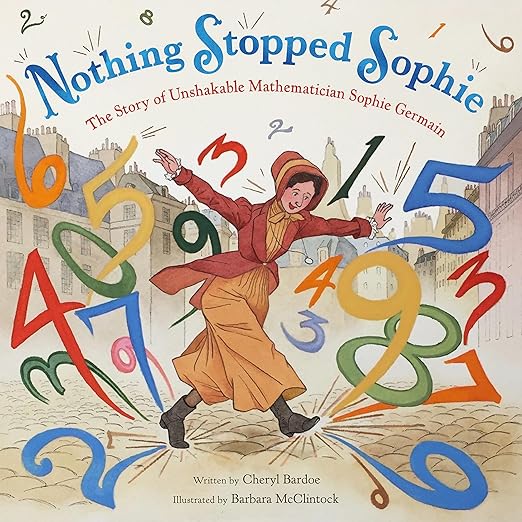
Nothing Stopped Sophie: The Story of Unshakable Mathematician Sophie Germain, by Cheryl Bardoe (2018)
Sophie Germain grew up during the French Revolution and found that the chaos outside her window made the order of mathematics feel like a refuge. Her parents did not agree. They thought studying math was dangerous for a girl's health, so they took away her candles at night to stop her from reading. Sophie just found more candles. Then she found ways to study in the cold and the dark. Nothing they did actually stopped her.
What I find most remarkable about her story is what she did once she ran out of ways to study officially. She got hold of lecture notes from university classes she was not allowed to attend in person, and submitted her work under a male name to avoid being dismissed. When the professor tracked down the mystery student and discovered she was a woman, he became one of her greatest supporters. That kind of reversal feels almost too good to be true and it really happened.
Cheryl Bardoe writes about Germain's determination in a way that never feels preachy and Barbara McClintock's illustrations give the whole book a period warmth that I really loved. In my opinion this is the most underrated of all the mathematician biographies for children and one of the most genuinely inspiring books on this list.

Counting on Katherine: How Katherine Johnson Saved Apollo 13, by Helaine Becker (2018)
Katherine Johnson loved to count and she never stopped. She counted the steps on the road, the dishes in the sink, the stars in the sky. That counting eventually led her to NASA, where she became one of the mathematicians calculating the trajectories that put American astronauts in space. In an era when Black women were kept out of almost every room that mattered, Katherine walked into those rooms and did work that nobody else could do.
I think what Helaine Becker gets right is showing Katherine's gift as something completely inseparable from who she was, not a special skill she applied at work but a fundamental part of how she experienced the world. Dow Phumiruk's illustrations are warm and radiant and they give Katherine's story the kind of visual dignity it deserves.
The Apollo 13 moment is genuinely gripping even though you already know how it ends. In my opinion this is one of the essential mathematician books for kids, not just because of the math but because of what Katherine represents. Brilliance finds its way through.

Blockhead: The Life of Fibonacci, by Joseph D'Agnese (2010)
Leonardo of Pisa got called Blockhead by his contemporaries because he kept talking about number systems that nobody in medieval Europe had ever heard of. He had grown up traveling the world with his merchant father and along the way he had picked up mathematics from Arab and Indian scholars, ideas that were centuries ahead of what was being taught back home. When he came back to Italy and wrote it all down, he changed how Europe counted.
What I love about this book is that it takes what could easily be a dry history lesson and makes it feel like an adventure instead. Joseph D'Agnese writes Leonardo as a curious, slightly eccentric kid who simply could not stop noticing beautiful patterns in numbers, and John O'Brien's illustrations have a lovely scratchy energy that suits the medieval setting perfectly. The Fibonacci sequence turns up in the natural world in ways that genuinely surprised me the first time I learned about it.
In my opinion Blockhead is one of the most quietly wonderful books on this entire list. It won the Mathical Book Prize for a reason. It teaches you something real without ever feeling like it is teaching you something, and that is a very hard thing to pull off.

Carl Gauss: The Boy who Out-Smarted His Teacher, by Kimberlee Everson (2025)
The story at the heart of this book is one of those real-life moments that sounds like it belongs in a movie. A teacher assigns his class what he thinks is an impossible task, add every number from one to one hundred, clearly hoping to be left in peace for an hour. Carl Gauss looks at the problem, sees the pattern hiding inside it, and has the answer in seconds. Not because he worked faster than everyone else but because he saw something nobody else had noticed.
Kimberlee Everson brings the same approach she used in her Blaise Pascal book, finding the human story inside the mathematical one and telling it in a way that makes you feel the thrill of discovery rather than the difficulty of the concept. I think that is harder to do than it looks and she pulls it off in both books. There is a real warmth to how she writes about these boys and their relationship with numbers.
In my opinion this and the Pascal book work best when you read them together. Both boys saw the world as a place full of patterns waiting to be noticed, and neither of them could have stopped thinking about numbers even if they had tried. If you have a child who feels that way, these two books will make them feel understood in the best possible way.
Final thoughts on mathematician books for kids
What makes these mathematician books for kids so special is that none of them are really about math. They are about courage, stubbornness, and the joy of following an idea wherever it leads. Pascal defied his father. Sophie Germain defied an entire society. Erdos defied convention his whole life. Each of these books hands a child a real person to admire, and the message underneath every story is the same. Your curiosity is worth fighting for. Pick any one of these up and you might just spark something that lasts a lifetime.


My profession is online marketing and software development (10+ years experience), a lot of AI related projects nowadays, check my latest works here. But my real passion is reading books both fiction and non-fiction. I have several favorite authors like James Redfield or Daniel Keyes. If I read a book I always want to find the best part of it, every book has its unique value.