Top 6+ Software Engineering Books AI Can’t Replace (2026)
AI can write code now, and it writes a lot. A developer with a good coding assistant can generate in an afternoon what used to take a week, and every month the tools get better. That has led many developers to a quiet, uncomfortable question: if AI writes the code, what am I actually for? The honest answer is that typing code was never the hardest part of the job. The hard part was always deciding what to build, how the pieces should fit together, which trade-offs to accept, and whether the result actually solves the problem. AI is fast at producing code. It is much weaker at knowing which code should exist in the first place.
These books cover the skills you need: modeling a business domain, designing systems that handle real data at scale, keeping complexity under control, making architecture decisions you can defend, building reliable products on top of AI models, and the professional habits that separate a great engineer from a fast typist. None of them will go out of date when the next model is released. If anything, they become more valuable as code gets cheaper, because the people who understand design are the ones who can tell good AI output from confident nonsense.
What Are The Best Software Engineering Books AI Can't Replace?

Learning Domain-Driven Design, by Vlad Khononov (2021)
Software usually fails not because the code is wrong but because it models the business wrong. Learning Domain-Driven Design is Vlad Khononov's practical guide to fixing that. He starts with strategic design: identifying a business's core, supporting, and generic subdomains, building a shared ubiquitous language with domain experts, and drawing bounded contexts so each part of a system has a clear meaning and a clear owner. Only then does he move to the tactical patterns, from aggregates and value objects to event-sourced models, and shows how domain-driven design connects to microservices, event-driven architecture, and data mesh.
A developer on X recently called this “a million dollar book,” and in the age of AI it's easy to see why. A coding assistant can produce a perfectly working class in seconds, but it can't sit with the people who run a business, understand where the money and the complexity really live, and decide where one model should end and another begin. That work is the heart of software design, and Khononov explains it more clearly and practically than almost anyone. Eric Evans's original Domain-Driven Design can feel dense and abstract. This book is the modern, readable way in, especially for developers who want to grow into architects or technical leads.

Designing Data-Intensive Applications, by Martin Kleppmann and Chris Riccomini (2026)
For nearly a decade, Designing Data-Intensive Applications has been the book engineers recommend when someone asks how real systems actually work underneath. It explains the ideas behind databases, replication, partitioning, transactions, consistency, and batch and stream processing, and, crucially, why each design choice comes with costs. The second edition, published in 2026 with Chris Riccomini joining Martin Kleppmann as co-author, brings the material up to date for a world of cloud-native infrastructure and modern data systems.
This is the kind of knowledge AI tools reliably lack in context. An assistant can write a query or configure a database, but it cannot know whether your system can tolerate stale reads, what happens to your data when a network partition hits, or why a choice that works at a thousand users will fall over at a million. Kleppmann's gift is making deep distributed systems ideas understandable without dumbing them down. It's a long, demanding read, and every chapter pays you back the first time production does something strange.
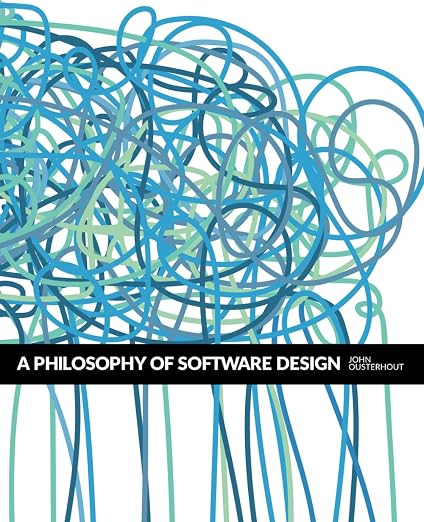
A Philosophy of Software Design, by John Ousterhout (2021)
John Ousterhout, a Stanford professor and the creator of the Tcl language, argues that the single most important problem in software is complexity, and that the whole job of design is fighting it. His short, opinionated book introduces ideas that have become part of how good engineers talk: deep modules that hide a lot of functionality behind a simple interface, information hiding, the difference between tactical and strategic programming, and the advice to design errors out of existence instead of handling them everywhere.
The book matters more now than when it was written. AI makes it almost free to produce code, which means it is also almost free to produce complexity: shallow wrappers, duplicated logic, and sprawling interfaces that each look reasonable in isolation. Ousterhout gives you the vocabulary and the taste to recognize that drift and push back against it, whether the code came from a teammate or a model. At around two hundred pages, it is the fastest way on this list to change how you review code.

Fundamentals of Software Architecture, by Mark Richards and Neal Ford (2025)
Mark Richards and Neal Ford open their book with two laws of software architecture: everything in software architecture is a trade-off, and why is more important than how. The rest of the book teaches you to live by them. It covers architecture characteristics such as scalability, availability, and maintainability, walks through the major architecture styles from layered and modular monoliths to microservices and event-driven systems, and shows how to document decisions so that future teams understand not just what was chosen but why. The second edition, published in 2025, updates the material for modern practice.
Trade-off thinking is precisely the skill AI cannot take off your hands. A model will happily propose microservices or a monolith with equal confidence, but it does not carry the responsibility of choosing, and it does not know your team, your budget, or your deadline. Richards and Ford give developers a structured way to reason about those choices and explain them to other people. It is the natural next step for any engineer who wants to be the person deciding the shape of a system rather than just filling it in.

AI Engineering, by Chip Huyen (2025)
If AI is changing the job, one of the best responses is to understand it properly. Chip Huyen's AI Engineering is the most complete guide to building real products on top of foundation models. It covers how to evaluate model outputs, which turns out to be one of the hardest problems in the field, along with prompt engineering, retrieval-augmented generation, agents, finetuning, dataset engineering, and how to make inference faster and cheaper. Throughout, Huyen focuses on the engineering decisions rather than the hype.
This book belongs on the list because it treats AI as a system you design, not a magic box you trust. The developers who thrive in the next few years will be the ones who know when a model is the right tool, how to measure whether it is working, and how to build guardrails around its failures. Huyen writes clearly and is refreshingly honest about what still does not work. It is essential for any developer whose product now includes AI features, and very helpful for anyone who wants to understand the tools writing their code.

The Pragmatic Programmer, by David Thomas and Andrew Hunt (2019)
The Pragmatic Programmer was first published in 1999, and the 20th anniversary edition rewrote much of it for modern development. Its advice is organized as short, memorable tips that have shaped generations of developers: don't repeat yourself, keep components orthogonal, use tracer bullets to find your target, don't program by coincidence, and take responsibility for your work instead of offering excuses. It is less a technical manual than a guide to thinking and acting like a professional.
That is exactly why it has aged so well. “Don't program by coincidence” may be the most important rule for anyone working with AI-generated code: if you do not understand why something works, you do not understand when it will break. The book's emphasis on ownership, curiosity, continuous learning, and caring about your craft describes the developer that no tool can replace. It is the warmest and most readable book on this list, and a good place to start if the others feel intimidating.
What Does a Developer Do After AI Writes the Code?
Read together, these six books describe a job that is shifting rather than disappearing. When code generation becomes cheap, the bottleneck moves upstream and downstream. Upstream, someone still has to understand the problem: talk to users and domain experts, decide what the system should do, and draw the boundaries between its parts. That is domain-driven design and architecture. Downstream, someone still has to judge the result, review the code for hidden complexity, check whether the data model will survive real traffic, measure whether an AI feature actually works, and take responsibility when it does not. That is design taste, systems knowledge and professional discipline.
In practice, the most valuable developers are becoming something like editors and architects of software. They write less code by hand and spend more time specifying, reviewing, testing, and deciding. They need to read code faster and more critically than ever, because they are reading far more of it. They need to explain tradeoffs to people who are not engineers. And they need a deep enough understanding of systems to know when an AI suggestion is subtly wrong, which is the most expensive kind of wrong. None of those skills come from autocomplete. All of them come from the kind of thinking these books teach.
Final Thoughts on Software Engineering Books AI Can't Replace
About a year ago, I stopped writing code. Not because I lost interest, but because I realized I no longer needed to type it myself. After Opus 5.5, it was clear there was no turning back. I could describe a feature in plain language, and a few minutes later I had working code that was often cleaner than what I would have written by hand. My job did not disappear. It moved. I now spend my days deciding what should be built, explaining the problem clearly enough for the AI to solve it, reviewing what comes back, and saying no to the solutions that look right but are not. Ironically, the books on this list became more useful to me after I stopped coding, not less. Every time I catch an AI drawing the wrong boundary between two parts of a system, or quietly adding complexity that will hurt us in six months, I am using exactly the kind of judgment these authors teach.
I believe the next few years will push this much further. AI agents will not just write functions. They will plan features, run tests, fix their own bugs, and ship changes while we sleep. The question will no longer be whether a human can write the code, but where a human needs to stay in the loop. I see that human role growing in a few clear places: defining what the business actually needs, setting the boundaries and rules the agents must respect, making the trade-offs that carry real consequences, reviewing the decisions that touch money, security, privacy, and people's trust, and taking responsibility when something goes wrong. Human in the loop will not mean a developer approving every line. It will mean a developer who understands the whole system well enough to know which few decisions truly matter, and to make them well.
The arrival of AI coding tools is not the end of software engineering. It is the end of software engineering as mostly typing. The parts of the job that remain are the parts that were always the most interesting: understanding problems, designing systems, making hard trade-offs, and building things people can rely on. Start with Learning Domain-Driven Design if you want to understand the business side of design, A Philosophy of Software Design if you want sharper instincts for clean code, and The Pragmatic Programmer if you want the mindset that ties it all together. Then go deeper with Designing Data-Intensive Applications, Fundamentals of Software Architecture, and AI Engineering. Read them, and you will not be competing with the AI. You will be the person telling it what to build.


My profession is online marketing and software development (10+ years experience), a lot of AI related projects nowadays, check my latest works here. But my real passion is reading books both fiction and non-fiction. I have several favorite authors like James Redfield or Daniel Keyes. If I read a book I always want to find the best part of it, every book has its unique value.